Technology Pipelines in Agriculture: Finding the Right Intervention Point
Agricultural R&D programmes are often rich in activity.
They contain excellent scientists, impressive projects, sophisticated technologies, trials, publications and reports. Yet despite this activity, many programmes struggle to translate scientific advances into measurable improvements in productivity and commercial outcomes.
The reason is not necessarily a lack of scientific capability.
Often, it is a lack of alignment.
The uncomfortable question that every R&D organisation should ask is:
Is the entire technology pipeline aligned with the main productivity problem we are trying to solve?
Technology push versus technology pull
Too often, R&D programmes operate as a technology push system.
A new tool, method, marker, model, trait or platform is developed, and only later do we ask where it might fit.
The result can be an impressive collection of projects at the front end of the innovation pipeline, but without a clear line of sight to the grower, the processor, the market, or the ultimate productivity outcome.
Discovery research is not the problem.
Discovery research is essential.
But discovery research becomes far more powerful when it sits inside a properly aligned technology pipeline.
A better model is a technology pull approach.
In this model, the starting point is not the technology.
The starting point is the problem.
And this leads to a question that I believe is often overlooked:
What is the right intervention point in the technology pipeline?
Most discussions focus on which technology should be used.
But in many cases, the more important question is:
Where in the pipeline should we intervene to create the greatest impact, with the highest probability of success, within the required timeframe?
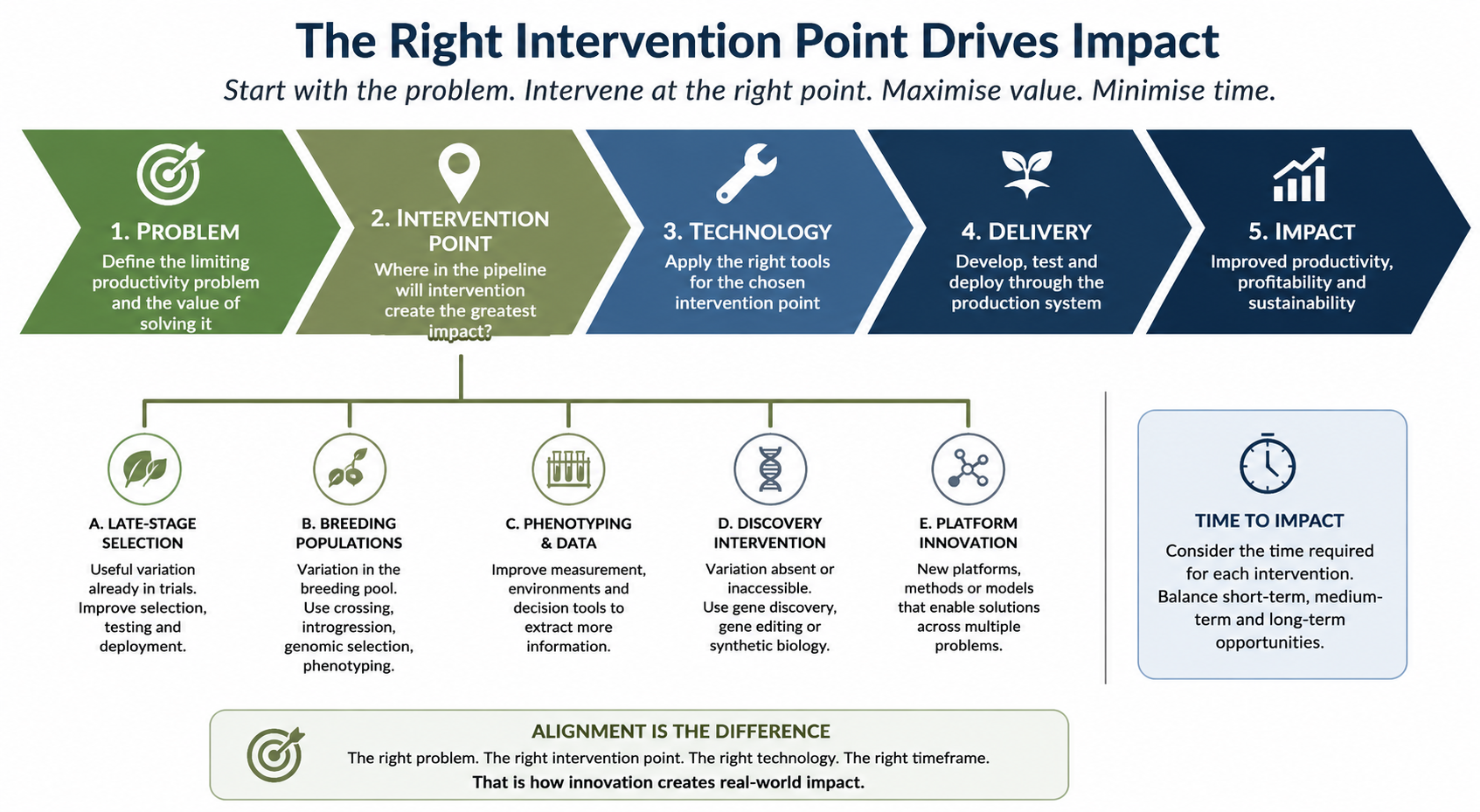
The answer may be:
- late-stage selection
- improved breeding populations
- better phenotyping
- more effective deployment
- or indeed a discovery intervention such as gene editing or synthetic biology
The problem is rarely the technology itself.
The problem is choosing the wrong intervention point.
Crop improvement as an example
In crop production this distinction is especially important.
If the challenge is biomass yield, drought resilience, disease resistance, ratooning ability, fibre quality, sugar accumulation, water-use efficiency or adaptation to a new production system, the first question should not be:
Can we use genomics, AI, gene editing or molecular biology?
The first question should be:
Do we already have useful variation in the late-stage selection pipeline?
If the answer is yes, the priority may be:
- better selection
- better testing environments
- better decision tools
- better deployment strategies
If the answer is no, the next question becomes:
Do we have sufficient variation in the breeding population or germplasm base?
If useful variation exists there, the solution may lie in crossing, introgression, improved phenotyping, genomic selection or more focused population development.
Only if the required variation is absent, inaccessible, too slow to recover, or biologically constrained should we move further upstream and ask:
Do we need a discovery intervention?
This is not an argument against advanced technologies.
It is an argument for putting them in the right place.
A fully aligned technology pipeline therefore connects:
Problem definition → Market need → Value proposition → Available variation → Breeding and selection → Advanced discovery tools → Deployment
The target is moving
There is another important point.
The end goal is not always fixed.
Markets change.
Processing technologies change.
Policy settings change.
New industries emerge.
A crop once selected mainly for sugar may later be evaluated for biomass, fibre, energy, carbon value, water productivity or compatibility with new processing systems.
A trait with limited commercial value today may become strategically important tomorrow.
Technology pipelines therefore cannot be static.
They need to evolve with the opportunity.
And they need to be reviewed regularly to ensure that the programme is still solving the right problem.
Time to delivery matters
There is also one element that is frequently underestimated:
Time to delivery.
In agricultural R&D this matters enormously.
Discovery projects are sometimes presented as if they can move smoothly from concept to product within a few years.
In reality, the path from discovery to field-ready technology is usually much longer, more uncertain and more expensive than initially assumed.
This is especially true in crop improvement.
A gene discovery project, a new molecular tool, a genome-editing concept, or a novel biological insight may be scientifically exciting.
But that does not mean it will deliver a commercial product within a realistic planning horizon.
The key question is not only:
Can this technology work?
It is also:
When can it deliver value?
And perhaps most importantly:
Is this the right intervention point in the pipeline?
For many production problems, the most effective intervention may not be the most advanced technology.
It may be:
- better use of existing genetic variation
- improved selection methods
- more targeted phenotyping
- better field testing
- faster deployment of material already in the pipeline
Auditing the technology pipeline
This is why time-to-impact should be part of every technology platform review.
A proper audit should ask:
- What can deliver value in 2–5 years?
- What may deliver value in 5–10 years?
- What is genuinely long-term discovery beyond 10 years?
- Are we confusing scientific promise with delivery readiness?
- Are resources balanced across short-, medium- and long-term opportunities?
Technology pipelines cannot simply be designed once and then left to run.
They need regular review.
They need honest auditing.
They need to be tested against a simple question:
Are we still solving the right problem, for the right market, with the right tools, at the right point in the pipeline?
Final thoughts
The strength of an R&D programme is not measured by how many technologies it contains.
Nor by how advanced those technologies appear to be.
It is measured by whether the programme can answer three questions clearly:
Are we solving the right problem?
Are we using the right intervention point in the pipeline?
Are we honest about the time required to deliver impact?
Because ultimately, progress is not measured by activity.
It is measured by how effectively knowledge is converted into value.
And that conversion depends on three things:
Solving the right problem.
Choosing the right intervention point.
Delivering impact within the required timeframe.
In agriculture, few things are more important than getting those three decisions right.