Analytical framework
An Integrated Analytical Framework
From feedstock potential to processing performance, system configuration and strategic decision-making.
FCB Advisory uses three connected quantitative models supported by a decision-analysis framework. Together, they connect biological potential, engineering performance and system design with the decisions that determine project value.
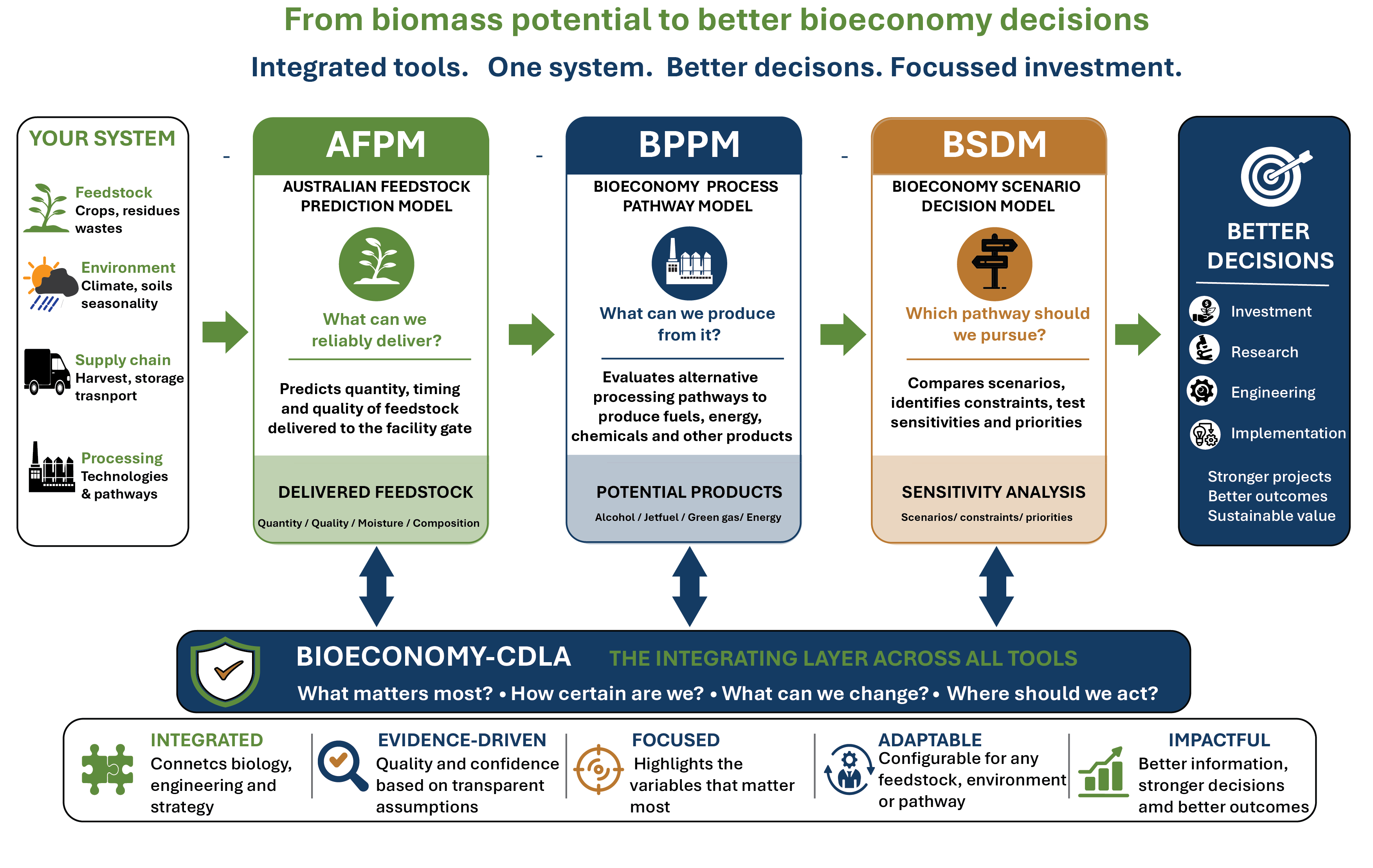
Quantitative models
Three connected views of the bioeconomy system
AFPM
Australian Feedstock Prediction Model
What biomass can realistically be supplied?
AFPM models the complete feedstock supply pathway. It integrates climate, crop development, biomass accumulation and partitioning, harvest recovery, moisture, physical form, transport and delivery.
Its principal output is a Feedstock Design Basis: a consistent engineering description of the biomass entering the processing system, including quantity, moisture, composition, bulk density, energy content and associated confidence.
AFPM helps determine:
- how much feedstock can be supplied;
- when and in what form it will be available;
- the implications for harvest, transport and storage; and
- which biological or supply-chain variables most affect reliable delivery.
BPPM
Bioeconomy Process Pathway Model
What can the delivered feedstock become?
BPPM evaluates how a defined feedstock can be transformed into products, energy and renewable carbon through alternative processing pathways.
It can represent pathways involving, for example:
- separation and fermentation of soluble fractions;
- biochemical conversion of lignocellulosic fractions;
- thermochemical conversion to syngas, fuels and products;
- anaerobic digestion to biomethane; and
- allocation of residues to process heat, electricity or alternative products.
Its principal output is a quantified process and product pathway linking feedstock characteristics to conversion performance.
BSDM
Bioeconomy Scenario & Decision Model
Which system configuration performs best?
BSDM integrates alternative feedstock, processing and product configurations to compare the performance of the system as a whole.
It helps answer questions such as:
- Which feedstock mix performs best?
- Which processing pathway creates the greatest value?
- What happens when feedstock availability or quality changes?
- How should products and residues be allocated?
- Where are the major system constraints?
- Which assumptions most affect the project outcome?
Its principal output is an integrated scenario comparison that makes trade-offs, dependencies and uncertainties visible.
Decision analysis
Bioeconomy-CDLA
Critical Decision Lever Analysis
What actually matters, what can be changed and where should action be taken?
Modelling can identify what influences an outcome. It does not, by itself, determine where intervention is worthwhile.
Bioeconomy-CDLA operates across the analytical framework. It combines model outputs with scientific evidence, uncertainty, actionability, technical feasibility, cost, risk and expected value. It can also incorporate experimental data, engineering analysis, literature evidence and expert knowledge independently of the three models.
The purpose is to identify the relatively small number of Critical Decision Levers where additional evidence, intervention or investment is most likely to improve the outcome.
Typical outputs include:
- sensitivity and uncertainty priorities;
- Critical Decision Lever rankings;
- evidence and verification priorities;
- research and development priorities;
- investment and implementation sequencing; and
- decision-gate recommendations.
From analysis to action
How the framework works
Biology → Engineering → Integration → Decision
AFPM establishes the biological and feedstock-supply basis. BPPM quantifies conversion pathways. BSDM integrates alternative system configurations. Bioeconomy-CDLA identifies where action is most likely to create value.
The result is a connected analytical pathway from understanding the resource to making a better-supported strategic decision.
Configured for the problem
Not a fixed model
The framework is configured around the project rather than forcing the project into a predetermined model. Feedstocks, production environments, harvesting systems, logistics, conversion technologies, products, economic assumptions and decision criteria can all be adapted to the specific problem being investigated.
These tools are therefore applied as part of an integrated advisory process—not offered as generic, stand-alone software products.