The bioeconomy technology pipeline is complex and includes at least seven processes.
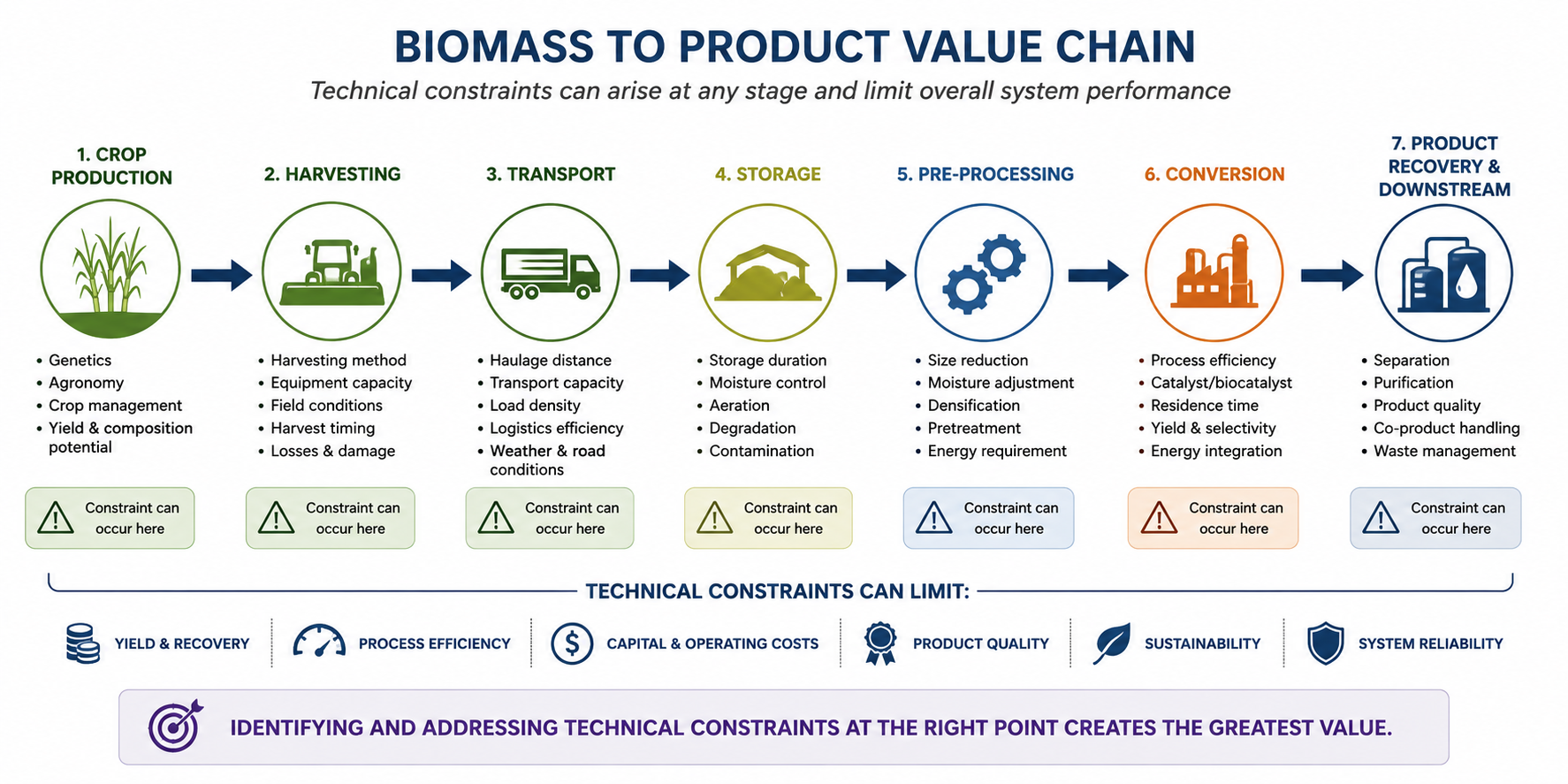
Where is the real constraint?
Scientific potential does not automatically translate into field performance, operational value or commercial deployment.
Complex biological systems contain many interacting variables, but only a small number usually determine overall performance.
A programme may invest heavily in genetics, omics, crop improvement, process technology or commercial development while the true limitation lies elsewhere—in carbon allocation, sink strength, environmental response, harvestability, feedstock quality, processing compatibility or the sequence of investment decisions.
Constraint Diagnostics provides a structured way to distinguish visible symptoms from the underlying factors that are actually limiting progress.
What We Diagnose
We analyse biological, technical and strategic constraints across the entire innovation pathway—from lab to field to market.
Typical Constraint Categories
- Biological performance
- Biomass quality and composition
- Processing compatibility
- Scale-up limitations
- Infrastructure and logistics
- Market alignment
Complex problems rarely have simple causes
Poor performance is often treated as an isolated technical problem. In complex biological and bioeconomy systems, however, the observed problem may be the result of interactions across several levels of the system.
A decline in crop yield may arise from altered carbon partitioning, reduced sink capacity, environmental sensitivity, agronomic mismatch or an unintended consequence of genetic manipulation.
Similarly, high biomass production does not necessarily translate into a successful feedstock. Moisture, composition, maturity, harvesting characteristics or processing requirements may ultimately determine its value.
Effective diagnosis therefore means looking beyond the visible problem to identify the constraints that actually control the outcome.
Biological constraints
Biological constraints determine the productive capacity, stability and quality of the crop or biological system.
They include carbon assimilation, source–sink relationships, carbon partitioning, development, environmental response and biomass composition.
Technical constraints
Technical constraints determine whether biological potential can be harvested, handled, stored and converted efficiently.
They include machinery, logistics, moisture management, feedstock variability, preprocessing, throughput and conversion performance.
Strategic constraints
Strategic constraints determine whether research, technology and capital are directed toward the factors that matter most.
They include research prioritisation, investment sequencing, uncertainty, technology readiness, implementation risk and market alignment.
Common symptoms can arise from very different underlying constraints
The table below illustrates problems encountered in crop science, biotechnology, biomass production and technology development. It shows why diagnosis must extend beyond the most obvious explanation.
| Observed problem | Possible underlying constraints | Primary diagnostic level |
|---|---|---|
| Yield decline despite continued genetic improvement | Reduced sink capacity; altered carbon partitioning; loss of physiological resilience; genotype × environment interactions; agronomic mismatch | Biological |
| Promising glasshouse results fail to translate into field performance | Controlled environments conceal heat, water, nutrient, soil and biotic stresses; trait expression may depend on developmental stage or crop architecture | Biological |
| Genetic manipulation improves a target trait but reduces total yield | Resource-allocation trade-offs; metabolic burden; altered source–sink balance; developmental penalties; reduced reproductive or storage capacity | Biological |
| Yield has plateaued despite increased inputs | The dominant limitation may no longer be water, nutrients or canopy size; sink strength, phenology or carbon allocation may have become limiting | Biological |
| High biomass production but poor feedstock quality | Excess moisture; unsuitable fibre composition; low fermentable fraction; high ash or mineral content; inappropriate harvest maturity | Biological / Technical |
| Large seasonal variation in feedstock quality | Genotype × environment × management interactions; variable maturity; harvest timing; storage deterioration; inconsistent sampling | Biological / Technical |
| Laboratory conversion efficiency cannot be reproduced at scale | Feedstock heterogeneity; mass- and heat-transfer limitations; preprocessing variability; equipment configuration; unrealistic laboratory assumptions | Technical |
| Processing throughput is lower than predicted | Particle size; moisture; bulk density; equipment limitations; fouling; handling constraints; feedstock inconsistency | Technical |
| Harvesting causes excessive biomass loss or contamination | Crop architecture unsuitable for machinery; poor harvest timing; equipment mismatch; soil contamination; insufficient field trafficability | Technical |
| A technically viable solution remains commercially unattractive | High logistics cost; low utilisation rate; seasonal supply; capital intensity; uncertain markets; insufficient scale | Strategic |
| Research programmes generate data but do not improve decisions | Questions are poorly framed; variables are measured without ranking their influence; uncertainty is not linked to a decision pathway | Strategic |
| Investment continues in a low-impact part of the system | The most visible or familiar problem is being addressed rather than the constraint with the greatest influence on overall performance | Strategic |
| A project advances before essential evidence is available | Technology readiness is overstated; critical assumptions remain untested; investment gates are unclear; evidence is not matched to risk | Strategic |
| Different specialists recommend conflicting solutions | Each discipline is optimising its own part of the system without considering system-wide interactions and trade-offs | Cross-system |
:::
:::