Why Biomass Variability Costs More Than Low Biomass Quality
Why consistency may matter more than achieving the highest feedstock specification.
Introduction
Biomass quality matters. Moisture content, ash, fibre composition, energy density, particle characteristics and contaminants can all influence how effectively biomass can be transported, handled and converted.
But there is another characteristic of biomass that may be just as important — and sometimes more important — than its average quality:
variability.
A processing facility does not operate on the average composition of the biomass produced during a season. It operates on the biomass arriving at the facility today.
That distinction has important consequences for the emerging bioeconomy.
Average quality can hide the real problem
Consider two biomass supplies.
The first has moderate quality, but its moisture content, composition and physical characteristics remain relatively constant. The second has a higher average quality, but individual loads vary substantially.
On paper, the second feedstock may appear preferable. But a processing facility does not operate on seasonal averages — it must process each individual load that arrives.
This distinction is illustrated in Figure 1.
Feedstock A has a lower average quality but relatively little variation between loads. Most of the biomass therefore falls within the range of feedstock characteristics that the processing system can accommodate efficiently.
Feedstock B has a higher average quality, but considerably greater variation. Although its average appears better, some individual loads fall outside the acceptable processing window. Those loads are more likely to require process adjustment, additional handling or preprocessing, or to result in reduced process performance.
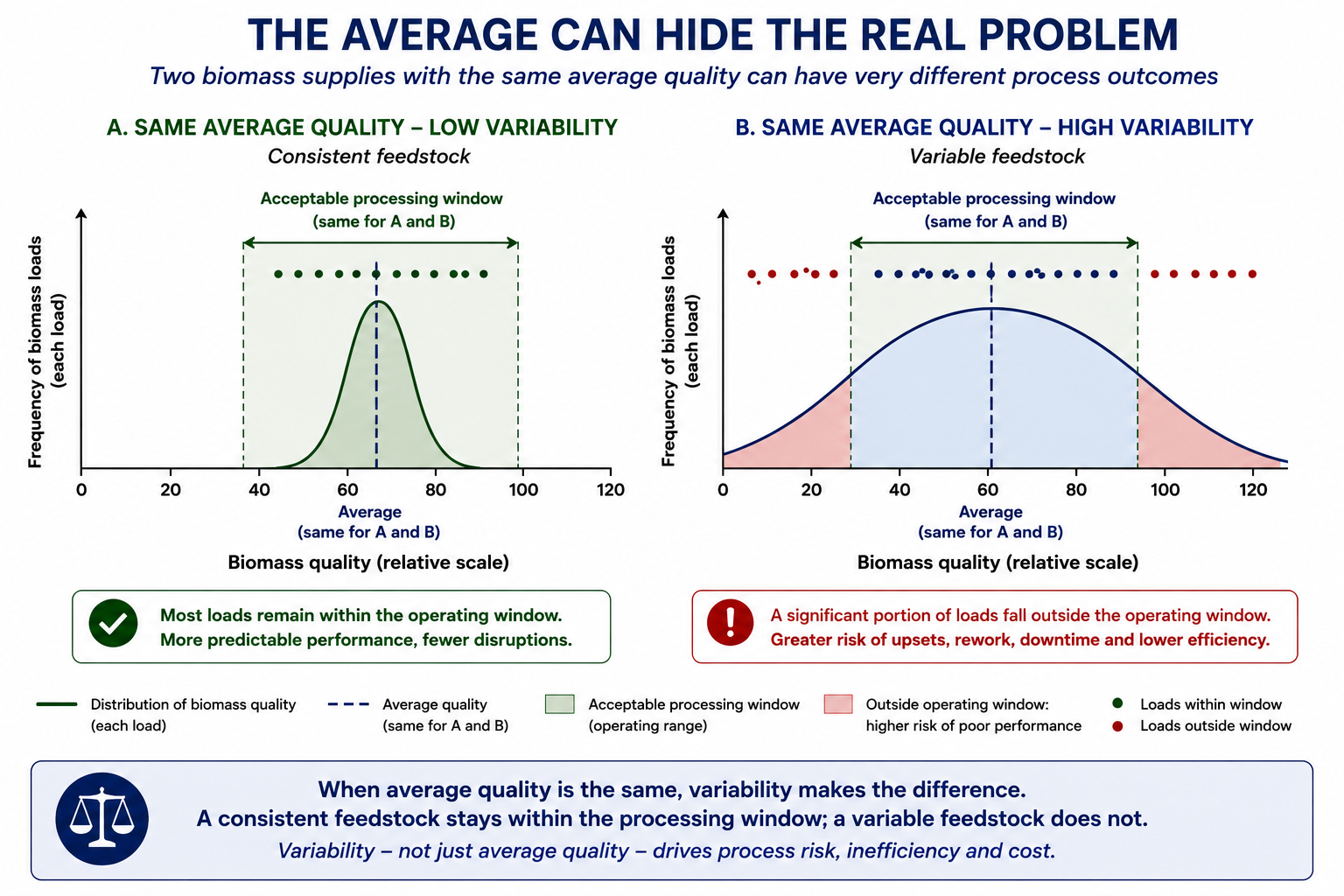
The important distinction is therefore between average quality and feedstock reliability.
A predictable feedstock allows equipment settings, material flows, energy requirements and conversion conditions to remain relatively stable. A highly variable feedstock creates a different problem: conditions that work well for one load may perform poorly for the next.
The important question is therefore not simply:
What is the average quality of the biomass?
It is also:
How much does that quality vary?
Biomass is not a manufactured raw material
Industrial processing systems often depend on raw materials produced within relatively narrow specifications.
Biomass is different.
It is the product of a biological system operating in a variable environment.
Crop variety, soil conditions, temperature, rainfall, irrigation, nutrient supply, crop maturity, harvest timing and seasonal conditions can all influence the biomass that ultimately arrives at a processing facility.
Variation can occur between regions, farms and fields. It can occur between harvest dates and seasons. It can even occur within a single field.
Harvesting, storage and transport can introduce further variation.
The result is a feedstock whose properties may change continually throughout the supply period.
This variability is not necessarily evidence of poor agricultural management. Much of it is an inherent consequence of using biological material as an industrial feedstock.
Variability propagates through the value chain
The importance of biomass variability becomes clearer when we follow it through the entire biomass-to-product pathway.
Variability originates in the biological system. Genotype, environment, crop maturity and management influence the quantity and characteristics of the biomass produced.
Those biological differences become feedstock differences. Moisture content, ash, fibre composition, soluble components, particle characteristics, contaminants and bulk density can all vary between loads.
The processing system then has to accommodate that variability.
Variation in moisture affects the amount of water transported with every tonne of dry matter and can alter storage behaviour, preprocessing requirements and energy demand. Variation in particle size and physical form can affect feeding, conveying, milling and equipment throughput. Variation in ash, lignin, structural carbohydrates or soluble sugars can influence conversion efficiency, process stability and product yield.
The consequences therefore extend beyond feedstock quality alone.
Variability in the biological system becomes variability in feedstock properties. Feedstock variability becomes variability in handling, throughput, energy demand and conversion. These effects ultimately influence product yield, operating cost, reliability and commercial risk.
Biological variability becomes engineering variability — and engineering variability ultimately becomes commercial variability.
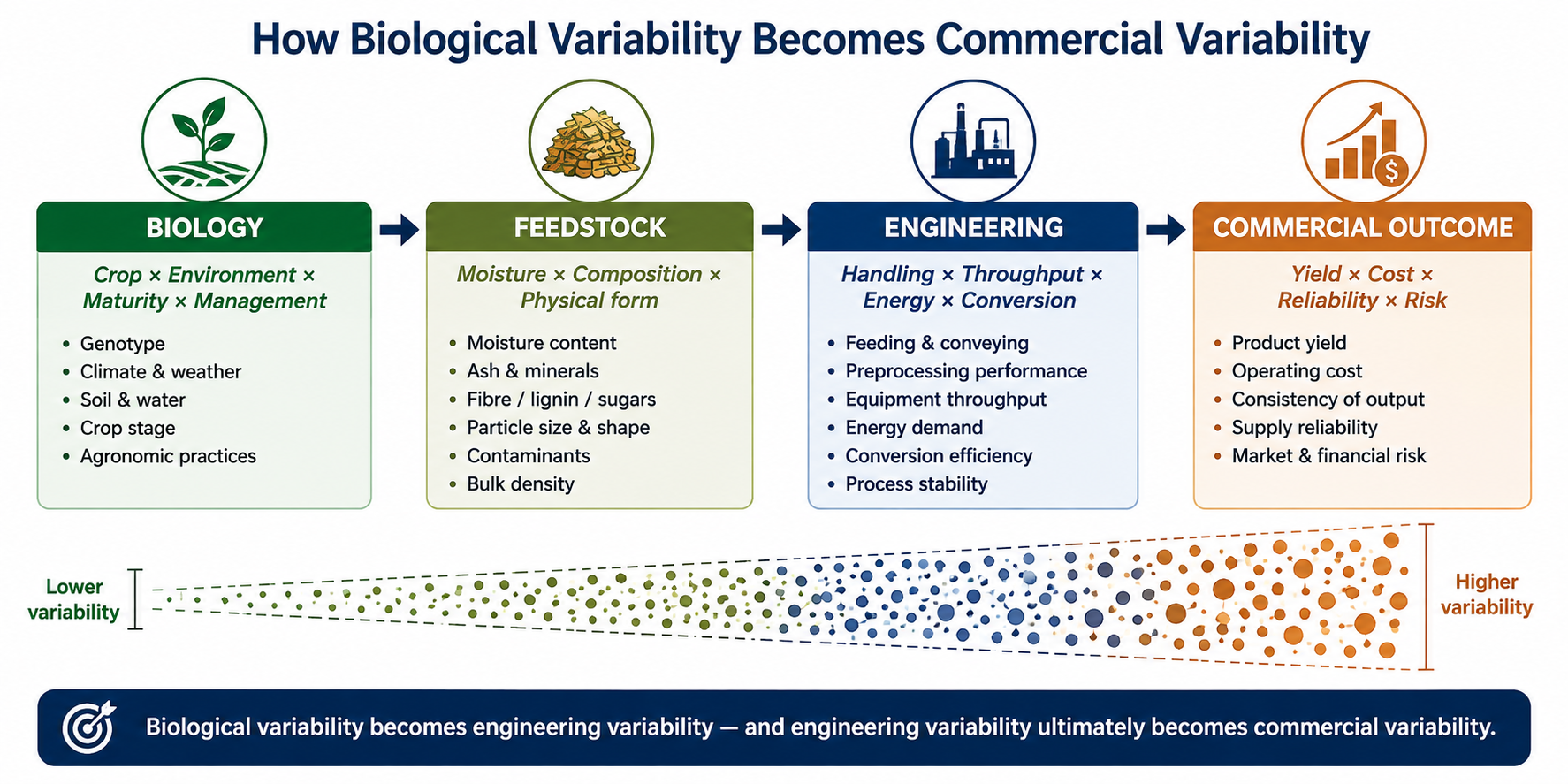
This propagation is important because each stage of the system has limits within which it performs efficiently.
Processing plants have operating windows
Every processing system has an operating window.
Within that window, material can be handled and converted efficiently. Outside it, throughput may decline, energy consumption may increase, product yield may fall, or additional intervention may be required.
A consistent feedstock allows the process to remain within that operating window for much of the time.
A variable feedstock repeatedly pushes the process toward its boundaries.
The consequences may include more frequent process adjustments, increased preprocessing, greater energy consumption, reduced throughput, variable product yield, increased maintenance and, in extreme cases, plant downtime.
This is where the cost of variability becomes important.
It is not simply the cost associated with processing a poorer load of biomass. It is the cost of continually adapting the processing system to a changing feedstock.
Consistently moderate may be better than occasionally excellent
This leads to a potentially counter-intuitive conclusion.
The highest-quality biomass may not necessarily be the most valuable biomass.
A feedstock of moderate but predictable quality may allow a facility to operate continuously at stable conditions. A feedstock with a superior average specification but much greater variability may require continual adjustment and may periodically move outside the preferred operating range.
The first feedstock can therefore deliver greater process stability even though its average quality is lower.
This distinction becomes particularly important when biomass specifications are developed.
Setting a minimum specification is relatively straightforward.
Managing the distribution around that specification is much more difficult.
Yet it may be the width of that distribution — rather than the average alone — that determines how reliably the processing facility performs.
The solution is not simply tighter specifications
It might be tempting to respond by imposing increasingly strict feedstock specifications.
That can simply move the problem upstream.
Rejecting biomass that falls outside a narrow specification may improve conditions at the processing plant, but it can increase losses, reduce available biomass supply and transfer financial risk to growers or biomass suppliers.
A better approach is to understand where variability originates and determine which sources of variation actually matter to the conversion process.
Some variability may have little commercial consequence.
Other variability may strongly affect throughput, conversion yield or operating cost.
The challenge is therefore to distinguish important variability from irrelevant variability.
This requires connecting biological measurements with engineering and economic performance.
Designing biomass supply for the conversion pathway
The objective of biomass production should not necessarily be to produce the highest possible quality feedstock.
It should be to deliver biomass that is fit for the intended conversion pathway.
That means understanding both the required average characteristics and the acceptable range around them. But it also means recognising that variability does not have to be controlled at only one point in the system.
Some variability can be reduced within the biological system through cultivar selection, crop management, planting windows or harvest maturity.
Harvest timing, harvesting sequence, transport planning and storage can reduce another component of variability before biomass reaches the processing facility.
Preprocessing provides further opportunities. Size reduction, drying, blending, conditioning and densification can transform a heterogeneous biological feedstock into a more uniform industrial input.
Finally, the conversion plant itself can be designed or operated to tolerate a defined range of feedstock characteristics through process control, buffer capacity and a sufficiently robust operating window.
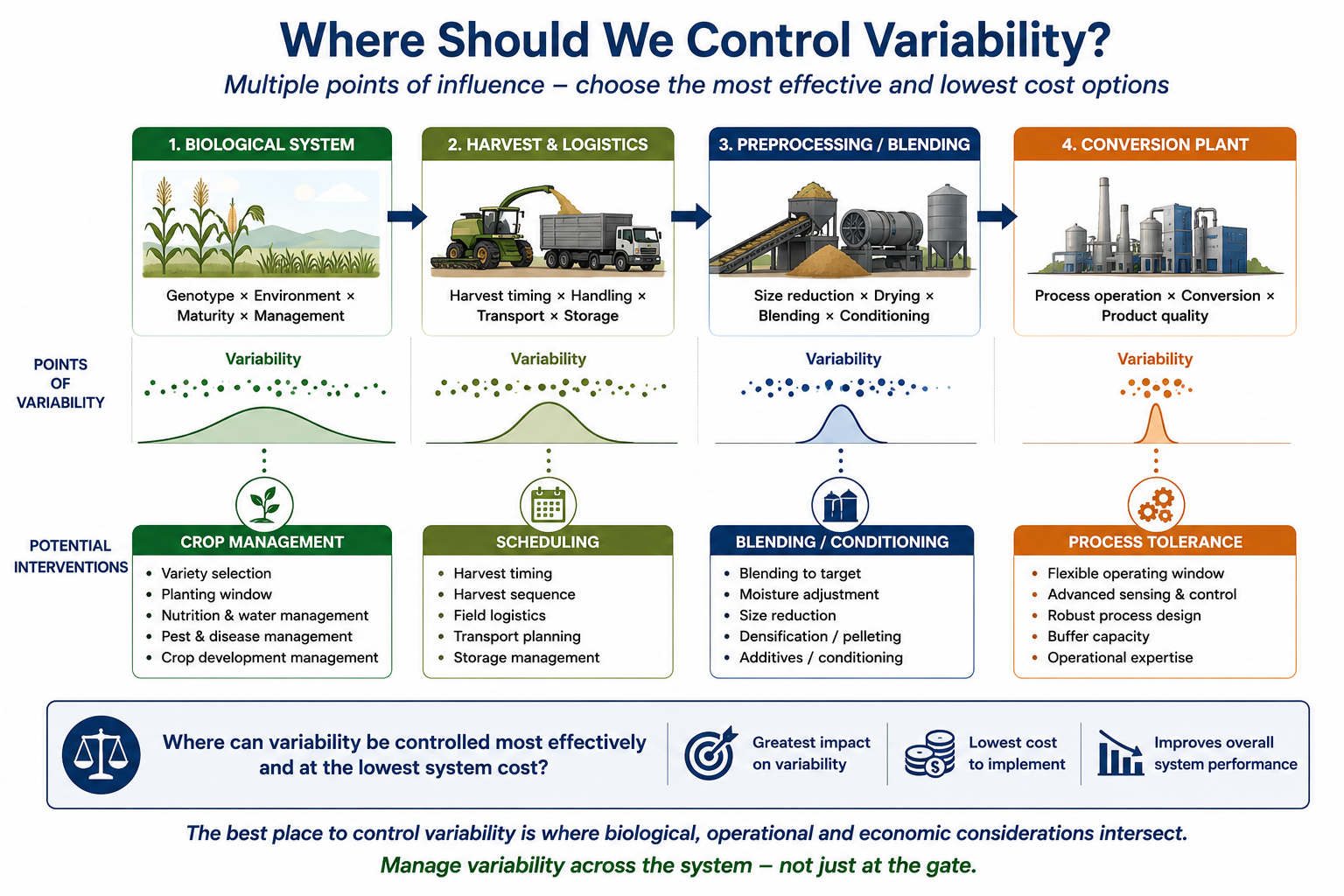
The important question is therefore not simply how can variability be reduced?
It is:
Where can variability be controlled most effectively and at the lowest system cost?
The answer may lie in crop management, harvesting and logistics, preprocessing, process design — or in a combination of all four.
This is why biomass specifications should not be developed independently of the conversion system they are intended to supply.
From biomass quality to biomass reliability
As the bioeconomy develops, biomass assessment will need to move beyond simple measures of yield and average composition.
The question is not only how much biomass can be produced, or even whether its average quality meets a specification.
We also need to know whether that biomass can be supplied consistently enough for an industrial system to depend upon it.
That is a different standard.
And it may ultimately be a more commercially important one.
The objective should not necessarily be to produce the highest-quality biomass. It should be to produce biomass of sufficient quality, with sufficiently low variability, for the intended conversion pathway.