Can Agricultural Waste Really Replace Fossil Fuels?
The arithmetic says no
Introduction
Agricultural waste occupies an attractive place in discussions about the emerging bioeconomy. Crop residues, processing by-products, forestry residues and organic wastes already exist, are widely distributed, and in many cases contain substantial quantities of recoverable carbon and energy. Their use can create value from material that might otherwise be discarded, reduce dependence on fossil resources, and provide additional revenue streams within agricultural and regional economies. These opportunities are real and should be pursued.
The difficulty arises when the existence of a large residue resource is allowed to imply that residues can provide biomass at the scale required to replace fossil carbon. The two propositions are not equivalent. The global fossil-energy system is extraordinarily large, whereas biological production is constrained by land, radiation, water, nutrients, climate and the competing functions that biomass already performs. Food, feed, fibre, soil protection, nutrient cycling and ecosystem function all draw on the same biological production that is increasingly being considered as a source of energy and renewable carbon.
This Perspective therefore begins with arithmetic rather than technology. It asks four sequential questions. First, how large is existing crop biomass relative to present fossil-energy consumption? Second, how much of the chemical energy in that biomass can actually become useful fuel or other products? Third, if existing biomass is insufficient, how can sustainable biomass supply be increased? Finally, if renewable biological carbon remains constrained, where should it be allocated?
These questions distinguish four quantities that are often blurred in bioeconomy discussions: biomass that exists, biomass that is sustainably available, biomass that can be recovered and delivered, and useful products that can be obtained after conversion. They also expose a more fundamental distinction between renewable energy and renewable carbon. Electricity can replace many fossil-energy services directly. It cannot, by itself, supply the carbon atoms incorporated into an organic chemical or polymer. Nor is direct electrification equally practical in every transport or industrial application. The strategic value of biomass therefore depends on more than its heating value.
This systems perspective is increasingly visible in policy. Australia’s 2026 National Bioenergy Feedstock Strategy, for example, recognises that feedstock development must move beyond theoretical resource estimates towards investment-ready supply, that production must expand and diversify, and that food and fibre systems must be protected. (Department of Agriculture, Fisheries and Forestry 2026) The same logic applies globally: a large bioeconomy cannot be built simply by finding more uses for the biomass already produced. It requires greater sustainable biological production, better recovery, conversion technologies matched to feedstock properties, and deliberate allocation of a limited renewable-carbon resource.
The scale problem: existing crop biomass is not enough
Start with the size of the fossil system
Global fossil-fuel consumption provides a useful scale against which biomass claims can be tested. The Statistical Review of World Energy 2024 reports approximately 505 EJ of fossil-energy consumption in 2023, representing more than four-fifths of global primary energy under the accounting convention used in that edition (Ersoy and Schaffer 2024). This number should not be interpreted as the quantity of biomass that a future low-carbon economy must replace one-for-one. Electrification changes conversion efficiencies and energy accounting, and the Energy Institute subsequently changed its primary-energy methodology. The comparison is instead an upper-bound scale test: how does the chemical energy contained in global crop production compare with the fossil-energy system from which modern economies currently obtain most of their carbon and energy?
The answer is sobering. Recent reconstruction of global crop production for 156 crops estimated 5.06 Gt dry matter (DM) of harvested crop biomass in 2023 and approximately 12.97 Gt DM of whole-crop biomass when above- and below-ground biomass were included. (Mariani and Ferrero 2026) The distinction is important. Harvested biomass includes the economically removed crop product; whole-crop biomass is a biological accounting quantity and includes material that is not practically or sustainably available for recovery.
An independent global food-system analysis estimated 4.33 Gt DM of harvested crops in 2011 with a gross energy content of 64.7 EJ (Alexander et al. 2017). This implies an average energy content of approximately 14.9 GJ t-1 DM. Applying that indicative average to the 2023 biomass estimates gives approximately 76 EJ yr-1 in harvested crop biomass and 194 EJ yr-1 in total crop biomass. The calculation is deliberately generous: it treats every tonne of crop dry matter as if its energy were accessible and gives no penalty for collection, competing uses or conversion.
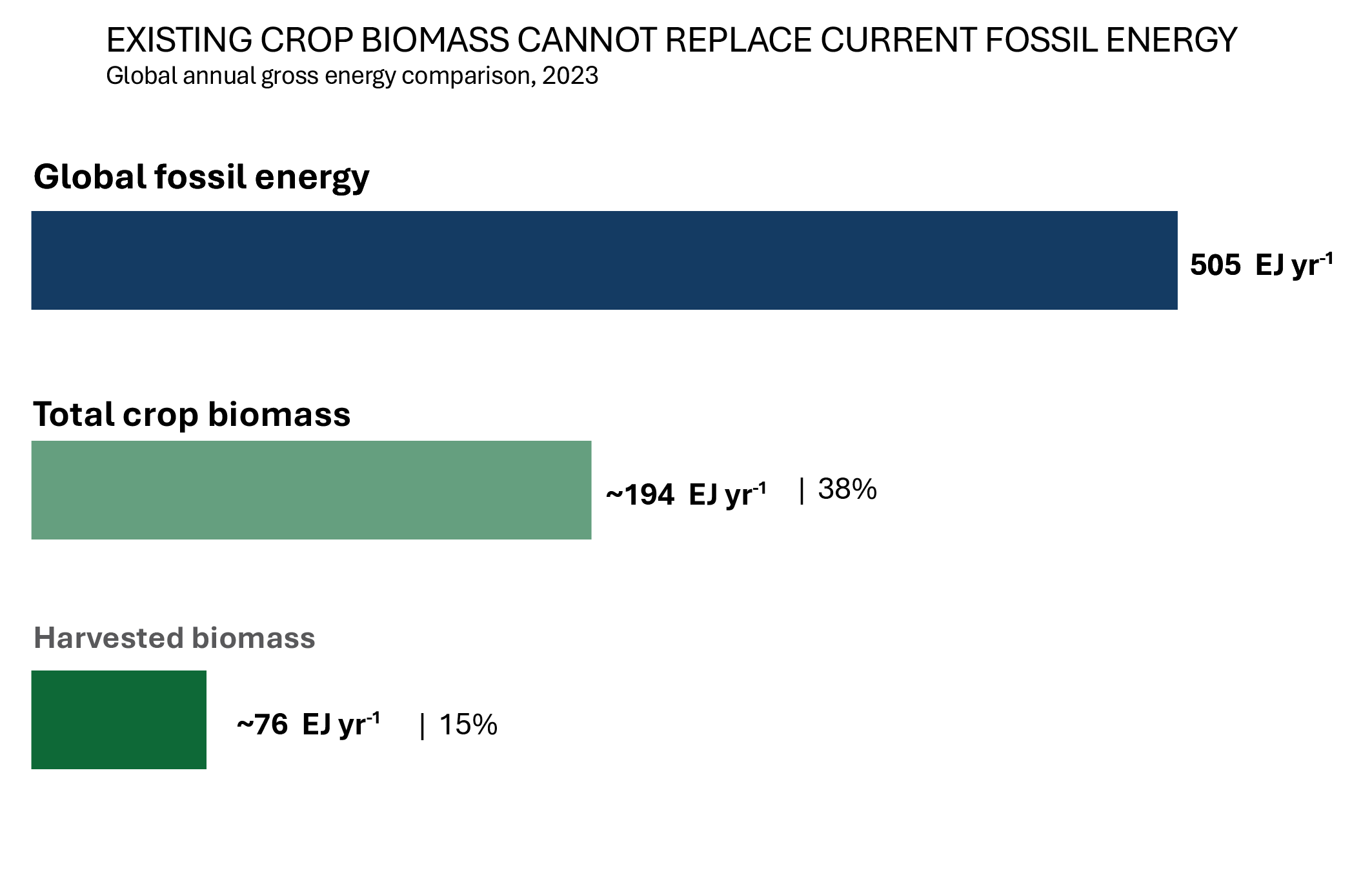
Figure 1 makes the scale problem visible. Harvested crop biomass contains gross chemical energy equivalent to only about 15% of present fossil-energy consumption. Even the extreme whole-crop calculation reaches only about 38%. The latter includes roots and other biomass that cannot plausibly be harvested in full, and both comparisons assume 100% recovery and 100% conversion of biomass energy to a useful energy carrier.
The purpose of the calculation is not to propose diversion of crops into energy, but to demonstrate the scale constraint. Even if the entire global crop were treated as an energy resource, an assumption incompatible with food security and ecosystem function, its gross energy content would remain substantially smaller than current fossil-energy use. Existing crop production cannot simultaneously continue performing its present functions and become a fossil-energy substitute of comparable scale.
Residue is not synonymous with available biomass
The term waste can obscure this constraint. Agricultural residues are often described as wastes because they are not the principal marketed crop product, but this does not mean that they have no existing function or value. Crop residues protect soil from erosion, return carbon and nutrients, influence water balance and soil physical properties, and may already be used for livestock feed, bedding, fuel or other products. Processing residues can similarly have established markets or internal process uses.
Global estimates demonstrate both the importance of the resource and the danger of interpreting a theoretical number as supply. Bentsen et al. estimated approximately 3.7 Gt DM yr-1 of residues from six major crops, corresponding to a theoretical energy potential of about 65 EJ yr-1 (Bentsen et al. 2014). This is a substantial quantity of energy. It is nevertheless a theoretical potential: it describes residue production, not the quantity that can be removed without unacceptable agronomic, environmental or economic consequences.
The distinction becomes clearer when estimates using different system boundaries are compared. Published assessments range from theoretical residue production to technical, sustainability-constrained and modelled future potentials (Dornburg et al. 2010; Searle and Malins 2015; Mensah et al. 2025). The values cannot be ranked as if they were repeated measurements of the same quantity. They differ in crops and waste streams included, reference year, recoverable fraction, land-use assumptions, environmental safeguards, competing uses and treatment of future production.
| Study | Biomass resource | Reported potential | Boundary |
|---|---|---|---|
| Bentsen et al. (2014) | Residues from six major crops | ~65 EJ yr-1 | Theoretical |
| Dornburg et al. (2010) | Crop residues | ~54–57 EJ yr-1 | Technical |
| Mensah et al. (2025) | Crop residues, 2050 | 60.4–64.9 EJ yr-1 | Modelled sustainable potential |
| Mensah et al. (2025) | Modelled wastes and residues, 2050 | 87.3–119 EJ yr-1 | Modelled sustainable potential |
Table 1 is therefore best read as a warning against false precision. Theoretical potential asks how much biomass or chemical energy exists. Technical potential introduces constraints on what can physically be collected or processed. Sustainable potential adds environmental and social constraints. Economic or deliverable potential must go further again by accounting for collection density, seasonality, transport, storage, infrastructure, quality and price. A conversion facility ultimately operates on the last of these, not the first.
This distinction is central to the arithmetic of agricultural waste. A residue resource can be globally large and strategically important while still being far too small—and too constrained—to function as a universal substitute for fossil carbon.
Gross biomass energy is not useful fuel energy
Biomass is chemically and physically heterogeneous
Even sustainably recoverable biomass does not become useful fuel without loss. The energy content of dry matter is therefore only the beginning of the conversion problem.
Biomass is not a homogeneous commodity. Sugar-rich crops contain readily accessible soluble carbohydrates. Starch crops store carbon in a polymer that can be hydrolysed relatively readily to fermentable sugars. Oilseeds concentrate highly reduced carbon in energy-dense lipids. Lignocellulosic biomass stores much of its carbon in cellulose, hemicellulose and lignin assembled into a structurally resistant cell wall. Wet organic wastes contain variable mixtures of carbohydrates, proteins and lipids, often at moisture contents that make drying unattractive. These differences determine both the feasible conversion pathways and the losses incurred.
| Feedstock | Dominant energy-bearing fraction | Principal pathway → product | Key consideration |
|---|---|---|---|
| Sugar-rich | Soluble sugars | Fermentation → ethanol, biochemicals | Carbon readily accessible; dilute or perishable streams may increase handling requirements |
| Starch-rich | Starch | Hydrolysis + fermentation → ethanol, biochemicals | Hydrolysis required; food/feed competition for some feedstocks |
| Oil/lipid-rich | Lipids | Transesterification or hydrotreating → biodiesel, renewable diesel, SAF | High energy density; feedstock availability and competing uses |
| Lignocellulosic | Cellulose, hemicellulose, lignin | Biochemical or thermochemical conversion → fuels, chemicals | Structural recalcitrance; pretreatment and incomplete utilisation |
| Wet organic biomass | Mixed biodegradable organics | Anaerobic digestion → biogas/biomethane | High moisture; yield strongly dependent on composition and degradability |
| Mixed residues/wastes | Variable | Feedstock-dependent | Heterogeneity may require sorting, preprocessing or blending |
Table 2 explains why a single biomass-to-fuel efficiency is not meaningful. The pathway must be matched to the feedstock. A tonne of sugar, a tonne of dry straw and a tonne of wet manure may all contain renewable carbon, but they present fundamentally different processing problems.
The energy-loss cascade
Three separate filters determine how much of gross biomass energy ultimately becomes useful fuel.
The first is availability. Food, feed, fibre, soil function and existing industrial uses remove part of biological production before energy recovery is considered. The second is physical recovery. Harvesting, collection, transport, storage and handling incur losses and impose economic constraints. The third is conversion. Fermentation, hydrolysis, anaerobic digestion, gasification, Fischer–Tropsch synthesis and lipid upgrading each conserve only part of the incoming chemical energy in the desired fuel product.
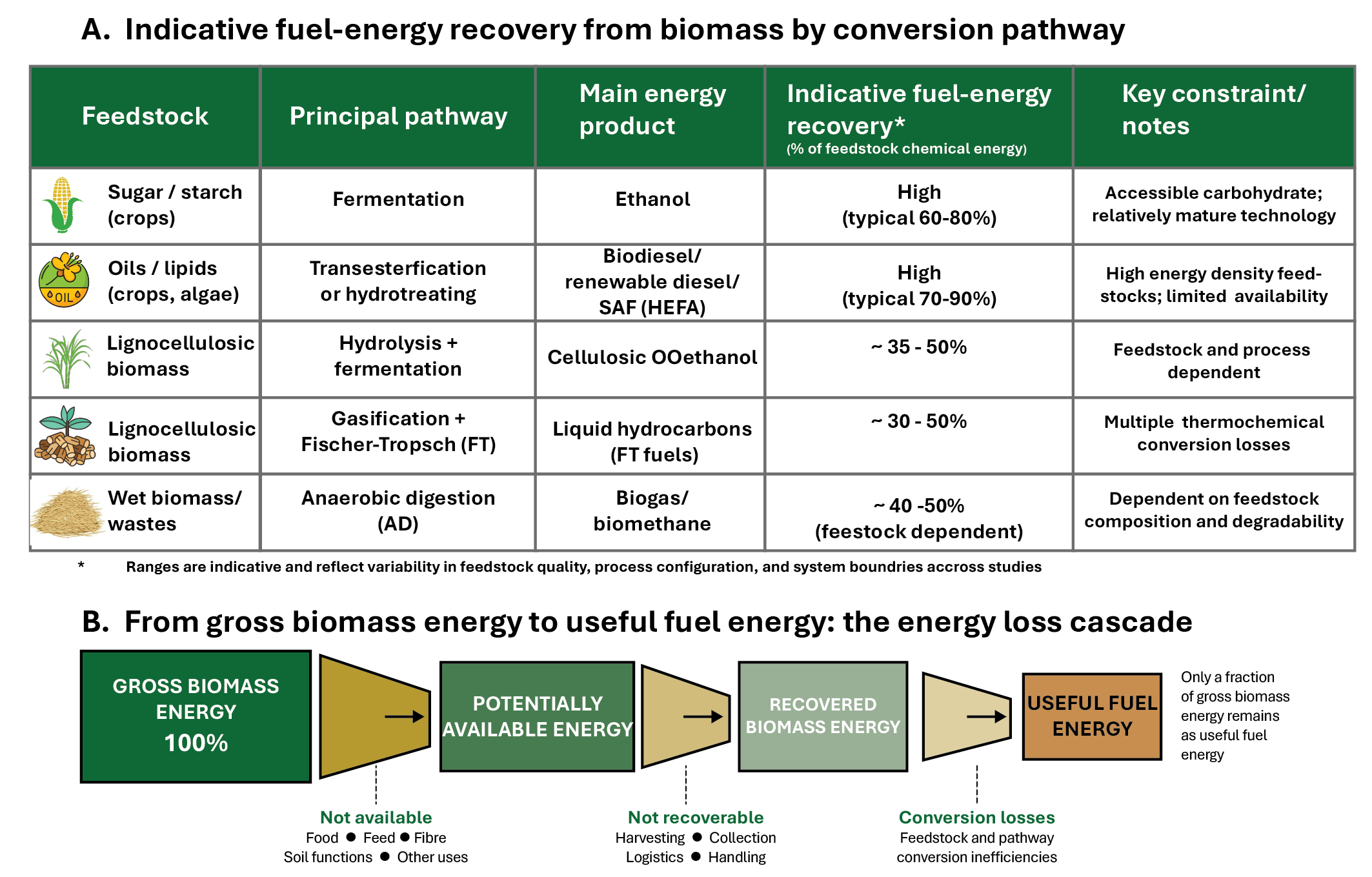
Figure 2 Figure 2 captures this contraction. The numerical ranges are indicative rather than directly comparable process guarantees because published efficiencies vary with feedstock, process configuration, product and system boundary (Hamelinck et al. 2005; Bai et al. 2008; Momayez et al. 2018; Ceaser et al. 2025; Ge et al. 2025). Their purpose is to show the direction and magnitude of the problem: useful fuel energy must be smaller than recovered biomass energy, which must in turn be smaller than gross biomass energy.
This point is especially important for lignocellulosic residues, which dominate many assessments of future biomass supply. Their abundance is attractive precisely because they are structural plant material rather than the primary harvested food product. But that same structural role makes them difficult to deconstruct. Cellulose accessibility, hemicellulose utilisation, lignin fate, pretreatment requirements and inhibitor formation influence biochemical conversion; thermochemical routes avoid enzymatic deconstruction but introduce their own gasification, gas-cleaning, synthesis and upgrading losses. There is no conversion technology that makes the biological and physical constraints disappear.
Consequently, statements such as “agricultural residues contain 65 EJ of energy” and “agricultural residues could provide 65 EJ of fuel” describe very different propositions. The first may be a legitimate gross-resource estimate. The second would require essentially complete sustainable recovery and complete conversion of chemical energy into the desired fuel—conditions that do not occur in practice.
A larger bioeconomy requires more biomass
The first two parts of the argument lead to an unavoidable conclusion. Better use of residues is necessary, but it cannot be the only biomass strategy. If biological carbon is to make a materially larger contribution to fuels, chemicals and materials, sustainable biomass production itself must increase.
This does not mean converting food-producing land indiscriminately to energy crops. Nor does it mean maximising tonnes of dry matter without regard to water, nutrients, emissions or ecosystem function. The relevant objective is greater production of useful, sustainably deliverable biomass per unit of constrained resource.
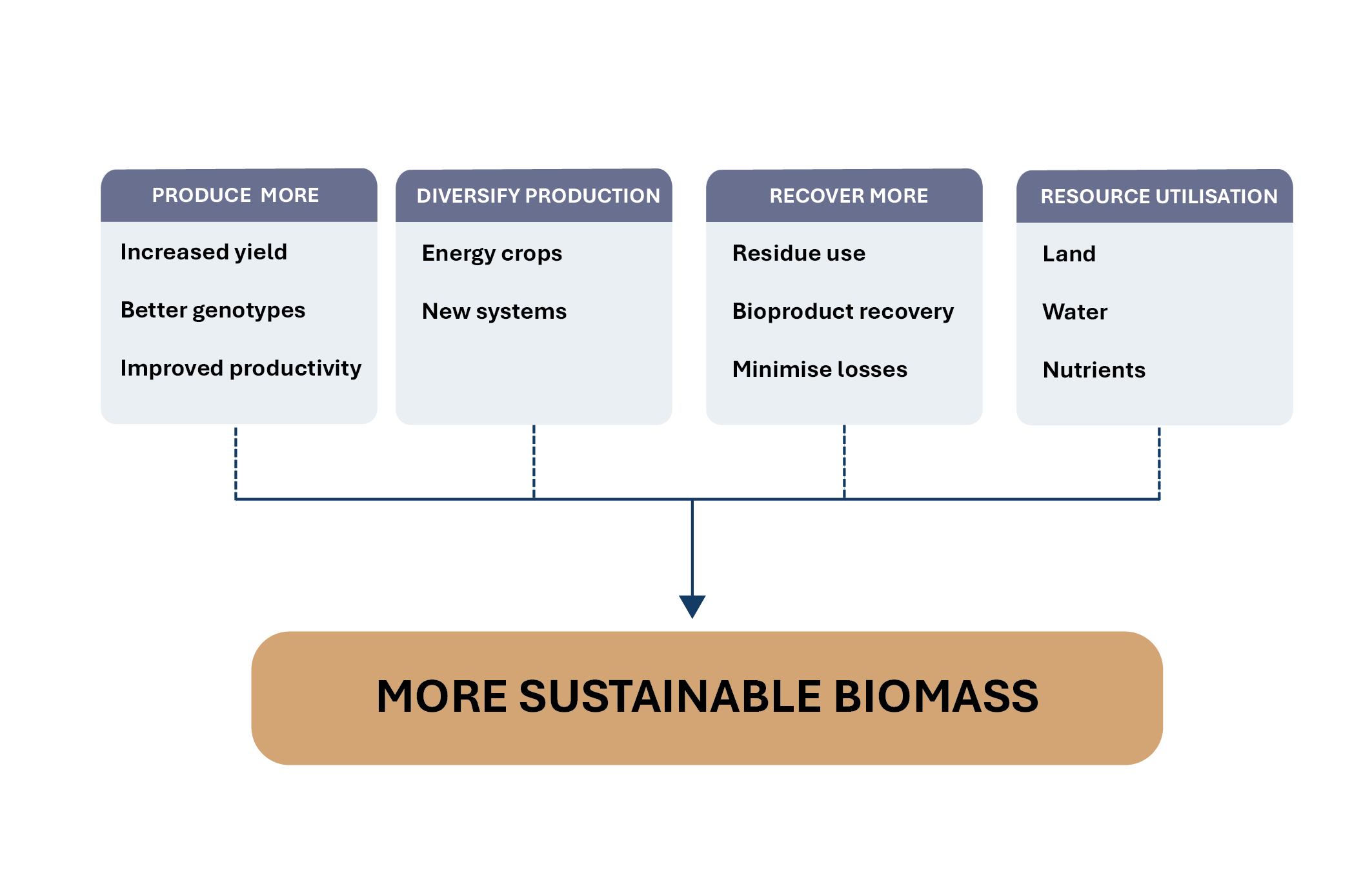
Figure 3 groups the production response into four complementary levers: produce more, diversify production, recover more, and improve resource utilisation.
Produce more: productivity before expansion
There remains substantial scope to increase crop production on existing agricultural land. Global yield-gap analysis has shown that improved nutrient and water management could close a substantial fraction of the difference between realised and attainable yields, although opportunities vary greatly among crops and regions (Mueller et al. 2012). The significance for the bioeconomy is broader than food yield alone.
Conventional crop improvement has often focused on the economically harvested organ: grain, sugar, oil, fibre or fruit. Biomass supply creates additional breeding and management objectives. Total dry-matter production, duration of canopy function, partitioning between harvested product and residue, tissue composition, moisture content, harvestability, ratooning or regrowth, stress tolerance and suitability for a conversion pathway can all influence the amount and value of biomass delivered. A crop optimised for grain yield is not necessarily optimised as a lignocellulosic feedstock.
This distinction also matters biologically. Biomass production ultimately depends on radiation capture, photosynthetic carbon assimilation, respiration, carbon allocation and the availability of water and nutrients. Raising harvest index can increase the economic yield of a crop without proportionally increasing total biological production. A bioeconomy seeking substantially more carbon must therefore consider not only how carbon is partitioned, but how much additional carbon can be fixed per unit land and resource input.
Diversify production rather than simply displace existing crops
New feedstocks can increase biomass supply where they exploit production opportunities not fully occupied by current systems. These opportunities may include annual or perennial energy crops, cover or fallow periods, double cropping, short-rotation woody crops, regionally adapted species and systems that integrate biomass production with existing food and fibre enterprises.
The distinction between new crops and new systems is important. A biomass crop that simply replaces a productive food crop may increase bioenergy supply while creating an equivalent pressure elsewhere. A crop inserted into a fallow, a perennial grown on genuinely suitable under-utilised land, or a system that produces a useful co-product alongside an existing crop can have a different system consequence.
Claims about “marginal land” therefore require caution. Land is often marginal because of low rainfall, poor soils, salinity, erosion risk, remoteness or other constraints that also restrict biomass productivity. Low value for conventional cropping does not imply zero ecological value or zero opportunity cost. The appropriate question is not whether land has been labelled marginal, but whether a particular feedstock can be produced there productively, economically and sustainably without creating unacceptable displacement or environmental effects {Blanco-Canqui (2016);Shortall (2013)}.
Recover more—but preserve the functions that matter
Residue recovery remains one of the most attractive ways to expand biomass supply because the primary crop has already been produced. Better harvesting, collection, storage, logistics and processing can convert material currently lost or under-used into feedstock. Processing by-products may be especially attractive where biomass is already concentrated at an industrial site (Alvarez 2024).
But recovery should be optimised rather than maximised. The amount that can be removed sustainably is location-specific. Soil type, climate, slope, cropping system, nutrient replacement, erosion risk and existing residue use all influence the appropriate recovery fraction. A residue removed for energy also exports carbon and nutrients that may otherwise have contributed to the production system. This is why the theoretical-to-deliverable hierarchy in Table 1 is not merely an engineering distinction; it is also a biological one.
Use land, water and nutrients more effectively
A bioeconomy cannot claim sustainability merely by substituting renewable carbon for fossil carbon if doing so creates disproportionate demands for land, irrigation water or nutrients. Resource productivity must therefore sit alongside biomass yield.
This changes the optimisation target. The highest-yielding crop is not automatically the best feedstock if its additional yield requires excessive irrigation, nitrogen, land preparation or transport. Conversely, a somewhat lower-yielding crop may be strategically attractive if it fits an existing rotation, uses a different seasonal water window, requires fewer inputs, provides soil benefits or produces biomass with superior conversion characteristics.
The emerging feedstock challenge is consequently one of systems productivity: useful biomass delivered per unit land, water, nutrient, energy, cost and environmental burden. This is also why no single global feedstock can solve the problem. Biomass production must be designed around regional biological opportunities and constraints.
Biomass is a strategic carbon resource
Producing and recovering more sustainable biomass does not eliminate scarcity. Land, water, nutrients and photosynthetic productivity remain finite, and biomass continues to have competing uses. The final question is therefore not simply how can more biomass be converted? It is where does limited renewable biological carbon create the greatest system value?
This question becomes clearer when energy and carbon are separated conceptually.
Not every fossil-energy service requires replacement carbon
Many fossil fuels are burned because an energy service is required: motion, heat or electricity. If that service can be provided directly by low-carbon electricity, replacing the fossil fuel with a carbon-containing biofuel may be unnecessary.
Direct electrification can also have a substantial efficiency advantage because it avoids the losses involved in producing, upgrading, transporting and reconverting an intermediate fuel. Recent analysis of transport pathways illustrates the scale of this effect: maintaining combustion-based road transport through synthetic fuels can require several times more primary renewable energy than direct electrification (Vossier et al. 2026). The exact ratio is technology- and boundary-dependent, but the principle is robust.
Jarin et al. extend this reasoning into an allocation framework based on comparative advantage (Jarin et al. 2026). Scarce low-carbon resources should not necessarily be sent to every application in which they can technically function. They should be allocated where their advantage relative to the available alternative is greatest. This is an important shift from asking whether biomass can replace a fossil fuel to asking whether biomass is the best use of scarce renewable carbon in that application.
Some applications remain difficult to electrify
The argument for direct electrification weakens where mass, volume, range, storage duration, infrastructure or process requirements make electrons difficult to use directly. Long-distance aviation is the clearest example. Aircraft require an energy carrier with exceptionally high specific energy, and the mass penalty associated with present battery technologies makes direct electrification much more difficult for long-haul operation than for road transport.
Maritime transport is more heterogeneous. Batteries may be practical for some short-distance operations, while hydrogen, ammonia, methanol, biofuels and other pathways compete for longer-distance applications. The appropriate conclusion is therefore not that shipping “must use biomass”, but that the relative value of molecular energy carriers rises as direct electrification becomes more difficult.
The same qualification applies to industry. Some industrial heat can be electrified efficiently; other high-temperature processes, existing assets or feedstock requirements are more difficult. A strategic allocation framework should therefore avoid assigning whole sectors permanently to one energy carrier. The relevant unit of analysis is the service or molecular requirement, not the sector label.
Chemicals reveal why renewable carbon is different from renewable energy
The distinction is strongest in chemicals and materials. Fossil resources are not used only as fuels; they are also sources of carbon atoms incorporated into products. Ethylene, propylene, aromatics, solvents, polymers and many other organic products contain carbon as matter. Electrifying the process energy does not remove this molecular carbon requirement.
A low-fossil-carbon chemical system therefore requires alternative carbon sources. These can include biomass, recycled carbon and carbon dioxide coupled with low-carbon hydrogen and energy. Biomass has a distinctive role because photosynthesis has already captured atmospheric carbon and assembled it into reduced organic molecules. That does not automatically make biomass the preferred carbon source for every chemical, but it means that its strategic value cannot be represented by heating value alone.
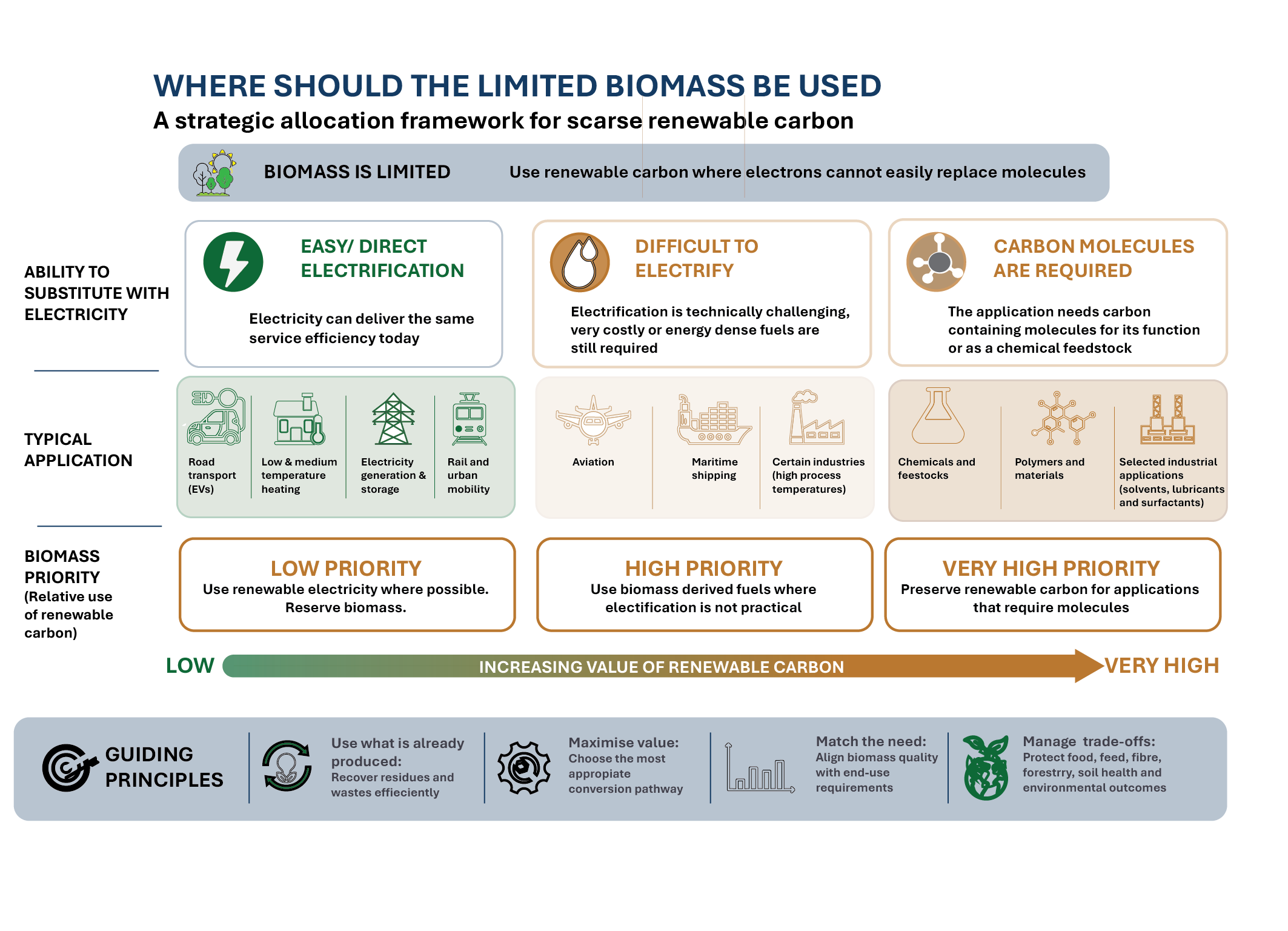
Figure 4 therefore represents the culmination of the argument rather than another conversion diagram. On the left are applications in which electricity can often provide the required service directly. In the centre are applications for which molecular energy carriers retain important practical advantages. On the right are applications in which carbon is required as material rather than merely as an energy carrier.
The progression should not be interpreted as an immutable ranking of sectors. Technologies change, and individual applications within a sector differ. It is instead a decision rule:
The stronger the requirement for a molecule, and the weaker the practical non-carbon alternatives, the stronger the case for allocating scarce renewable biomass to that use.
This reframes biomass from a generic renewable-energy commodity into a strategic renewable-carbon resource.
From biomass potential to bioeconomy strategy
Taken together, the four figures point to a different way of thinking about bioeconomy scale.
The first requirement is to stop equating theoretical biomass with available feedstock. Resource assessments should explicitly distinguish gross production, competing uses, sustainable removal, technical recovery, economic delivery and conversion yield. A global residue number expressed in EJ may be useful for bounding the problem, but investment decisions depend on tonnes of feedstock of known composition, moisture, seasonality, location, cost and reliability.
The second is to design feedstock and conversion together. Biomass composition is not a nuisance variable to be accommodated after a plant has been designed. It determines conversion options, product yields, preprocessing requirements and process stability. Feedstock-development programmes should therefore consider conversion characteristics alongside agronomic yield.
The third is to treat increased sustainable biological production as part of the solution. Residues and wastes should be recovered where doing so is sustainable and economic, but a large bioeconomy cannot be built solely by redistributing current biological production. Higher productivity, improved genotypes, new crops, better rotations and new production windows will be required if the supply of renewable carbon is to grow materially.
The fourth is to optimise resource use rather than biomass tonnage alone. Land, water, nutrients, energy, infrastructure and ecological functions all impose constraints. The relevant performance measure is therefore not simply tonnes per hectare, but useful and reliably deliverable biomass relative to the resources and impacts required to produce it.
Finally, biomass should be allocated strategically. Using renewable carbon to provide an energy service that can be supplied more efficiently by direct electricity carries an opportunity cost: the same carbon is then unavailable for an application in which molecules are much harder to replace. This does not require central prescription of every tonne of biomass. It does require policy, markets and project assessment to recognise that different uses of renewable carbon have different system consequences.
This is also where national feedstock strategies become important. Australia’s emerging approach explicitly seeks better data, increased productivity, diversified feedstocks, regionally tailored supply chains and integration with food and fibre production. (Department of Agriculture, Fisheries and Forestry 2026) Those priorities are consistent with the global arithmetic presented here. The challenge is not simply to identify biomass resources; it is to convert theoretical potential into sustainable, reliable and conversion-appropriate supply.
Conclusions
Agricultural wastes and residues are valuable resources. Recovering more of them should be an important component of the bioeconomy. But their value should not be confused with sufficiency.
The arithmetic sets the boundary. Current harvested crop biomass contains gross chemical energy equivalent to only a small fraction of present fossil-energy use, and even an impossible whole-crop recovery scenario remains far below the scale of the fossil system. Residues add an important resource, but theoretical residue production contracts when soil functions, competing uses, recovery, logistics and conversion losses are recognised.
A materially larger bioeconomy therefore requires more than better waste utilisation. It requires greater sustainable biological productivity, diversification of feedstock production, improved recovery of residues and by-products, and better use of land, water and nutrients. It also requires conversion pathways to be selected around the chemical and physical properties of the feedstock rather than treating biomass as interchangeable.
Most importantly, biomass scarcity changes the allocation question. Renewable electricity can provide many energy services without renewable carbon. Other applications remain difficult to electrify, while chemicals and materials may require carbon atoms in the product itself. Biomass should therefore not be valued only by the energy it contains. Its distinctive strategic value is its capacity to provide renewable carbon as well as renewable energy.
The limitation of biomass is consequently not an argument against the bioeconomy. It is an argument for a more disciplined bioeconomy: produce more sustainable biomass, recover it intelligently, convert it efficiently, and preserve scarce renewable carbon for the applications in which renewable carbon is hardest to replace.